



5MW Energy Storage Container Test System: High-Power Validation for Utility-Scale ESS
Updated:2026-10-16


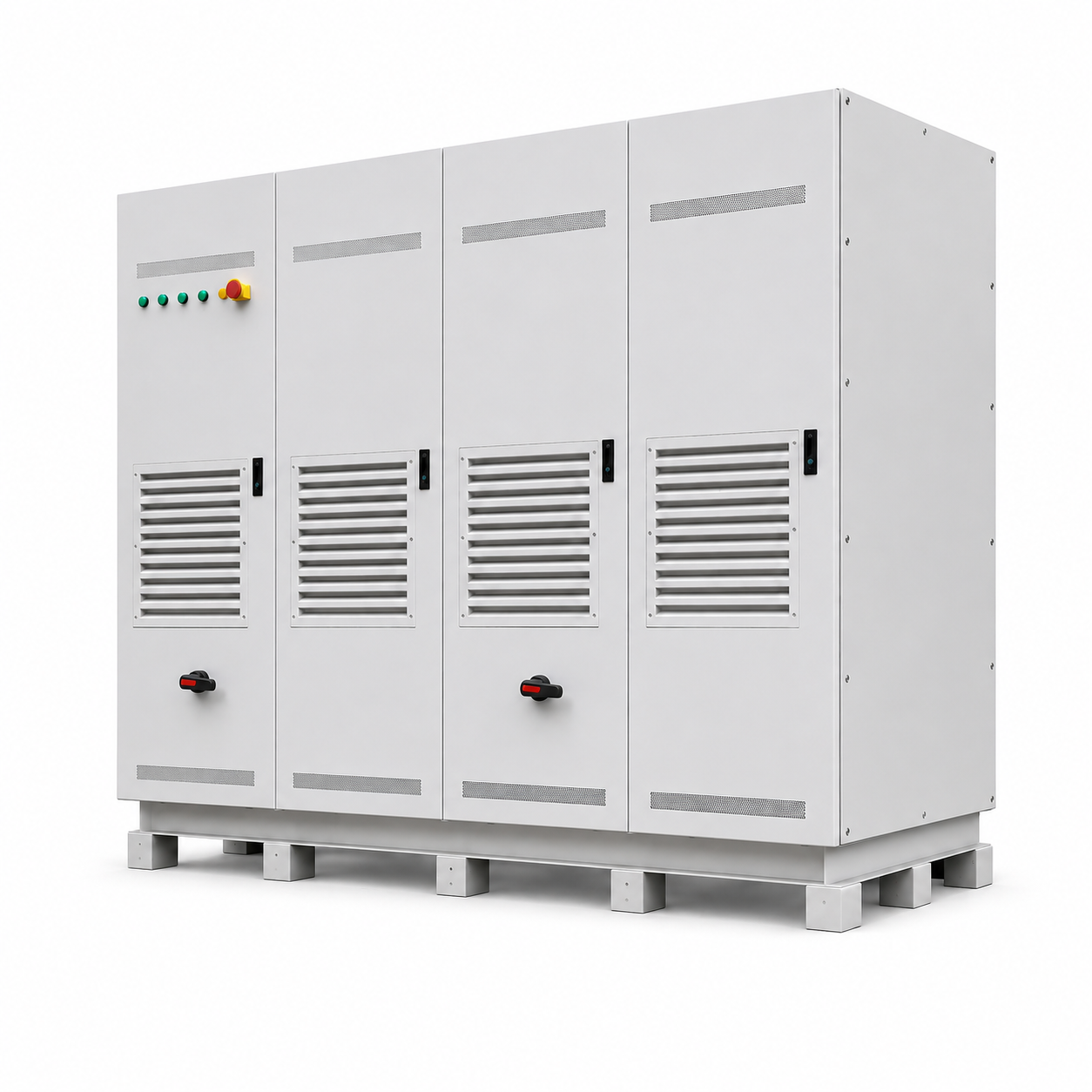
BT-2000V3200A1CH5000kW high-power bidirectional energy storage container test system.
Why Utility-Scale Energy Storage Requires Dedicated Test Equipment
A containerized ESS integrates thousands of cells, multiple battery clusters, BMS hardware, contactors, protection devices and thermal-management components. A fault or control issue that is difficult to detect at module level may become significant when the full system operates at megawatt power.
Traditional PCS-based test arrangements can be constrained when battery clusters with different states of health share a common DC bus. Voltage coupling makes independent control more difficult, while a fault on the shared bus can affect a larger part of the test setup. A purpose-built bidirectional charge-discharge platform provides programmable test profiles, controlled measurement, dedicated protection and structured data acquisition for repeatable validation.
For manufacturers, system integrators and laboratories, this means one platform can support:
- Factory inspection and acceptance testing
- Capacity and energy verification
- Charge-discharge characteristic testing
- Cycle-life and durability testing
- DC internal resistance (DCIR) testing
- Overcharge and overdischarge tolerance evaluation
- Simulation of actual grid-storage operating profiles
- BMS data verification and protection-threshold validation
Core Electrical Specifications
The BT-2000V3200A1CH5000kW combines high power with precision measurement and fast response.
| Parameter | Specification |
|---|---|
| Model | BT-2000V3200A1CH5000kW |
| Output channels | 1 |
| Charge-discharge voltage range | 50-2000V DC; supports charging from 0V |
| Output current range | -3200A to +3200A |
| Maximum output power | 5000kW |
| Voltage measurement and control accuracy | 0.05% F.S. |
| Current measurement and control accuracy | 0.05% F.S. |
| Voltage/current acquisition resolution | 16 bit |
| Current rise/fall time | ≤10ms, from 10% to 90% F.S. |
| Charge-discharge transition time | ≤20ms, from -90% to +90% F.S. |
| Minimum data-recording interval | 10ms |
| Maximum equipment efficiency | 95% |
| Power factor | 0.99 |
| Current harmonic distortion | <5% |
| BMS interfaces | CAN 2.0 and RS485 |
| Cooling / protection level | Air cooling / IP20 |
| Operating environment | 0-45°C; 0-95% RH non-condensing; altitude up to 3000m |
F.S. means full scale. Accuracy values should be interpreted against the configured full-scale range rather than as a percentage of each instantaneous reading.
Regenerative Testing Reduces Net Energy Consumption
During high-power battery discharge, conventional load equipment converts a large amount of electrical energy into heat. This increases electricity use and places additional demands on cooling and facility infrastructure.
The Brilliance Technology system uses bidirectional power conversion to feed discharge energy back for reuse. Recovered energy may support other electrical loads or, in a multi-system test arrangement, help charge another energy storage unit. When one unit is charging while another is discharging, the test bench can establish an internal energy circulation path. The external power supply then mainly covers conversion losses and system auxiliaries.
This approach can reduce net electricity consumption, cooling requirements and operating cost during repeated charge-discharge testing. Actual savings depend on the test profile, battery efficiency, power matching, facility configuration and operating conditions.
Programmable Charge-Discharge Profiles
The platform supports constant-current (CC), constant-current/constant-voltage (CC-CV), constant-power, ramp-current, pulse and operating-condition simulation modes. Discharge testing additionally supports constant-resistance operation.
The system supports 1 to 65,535 test cycles, more than 254 steps within a single cycle and up to five levels of nested loops. Engineers can define cut-off conditions using total voltage, total current, time, internal resistance, accumulated Ah, accumulated Wh and BMS measurements.
The specified current rise/fall time is no more than 10ms, while charge-discharge transition is no more than 20ms. Smooth switching without current overshoot helps protect the device under test and improves the consistency of recorded results.
BMS Communication and DBC File Support
The system supports CAN 2.0 and RS485 communication, together with DBC file import, to acquire compatible BMS signals in real time. Typical values include pack voltage and current, SOC, cell voltage, cell-voltage difference, cell temperature and temperature difference.
BMS data can be synchronized with the tester’s measurements and used as test-step judgment conditions. A procedure can stop, switch or skip a step when a defined limit is reached. Protocol definitions and available signals should be confirmed for each battery project.
Real-Time Data Acquisition and Analysis
The host-computer software displays current, voltage, charge-discharge capacity, operating step and channel status in real time. A minimum recording interval of 10ms provides detailed visibility into dynamic test events.
Engineers can plot test curves, review historical records and export results in Excel-compatible or TXT formats. Statistical outputs include Ah, Wh, internal resistance, SOC, individual cell voltage, cell temperature and cell-to-cell differences.
Power-off resume and offline testing functions add resilience to long-duration programs. Breakpoint data can be retained after a power interruption, while the lower-level controller can continue testing and storing data if the host computer becomes unavailable.
Multi-Layer Protection for High-Power Testing
- Grid undervoltage, overvoltage, overcurrent, short-circuit and phase-loss protection
- Battery-side undervoltage, overvoltage, overcurrent, short-circuit and reverse-polarity protection
- Configurable voltage, current and temperature limits
- Individual-cell voltage and temperature alarms through BMS data
- Voltage clamping and dynamic load protection
- Automatic battery disconnection after external power loss
- Independent emergency-stop protection
Protection thresholds must be configured for the battery under test. Equipment protection complements, but does not replace, an approved test procedure, site risk assessment, interlocks, fire protection and other facility safety measures.
A Scalable Platform for ESS Manufacturers and Test Laboratories
The modular bidirectional architecture can be adapted to different project requirements. Depending on the system design, converter units can be combined for high-power container testing or separated for more granular battery-cluster evaluation. This flexibility helps manufacturers use test capacity efficiently across R&D, pilot production and factory acceptance workflows.
The standard project configuration may include the industrial computer and monitoring peripherals, charge-discharge test equipment, DC output cables, host-computer software, user documentation and a factory test report. Final cable length, AC input configuration, site construction, installation responsibilities, communication protocol and safety interfaces should be confirmed during project engineering.
Plan Your 5MW Energy Storage Test Project
For project evaluation, provide the battery voltage range, maximum charge-discharge current, continuous and peak power, channel requirements, test profiles, BMS protocol, data-recording requirements, facility AC power, cable distance and installation environment.
Brilliance Technology provides battery testing equipment and integrated test solutions for battery cells, modules, packs and high-voltage energy storage systems.
Contact Shenzhen Brilliance Technology Co., Ltd. to discuss your 5MW energy storage container testing requirements.
- Website: www.szbrilliance.com
- Email: stephen.miao@szbrilliance.com
- WhatsApp: +86 138 2355 2231